
Your AI rollout is Transformation Change that happens to involve technology.
By Emily Zhang, Founder — HumAIn Impact | 15+ years in People & Culture, Cange Transformation across KPMG, CBA, Westpac, Startup Fintech. · 17 June 2026

88% of organisations are using AI. Only 1% report reaching AI maturity. The gap between those two numbers is not a technology problem, it is a people adoption problem.
88% of organisations use AI in at least one function (McKinsey, 2025)
1% report reaching AI maturity
70% of transformation initiatives fail to meet objectivesSomewhere in your organisation right now, a leadership conversation is happening that goes something like this.
The CTO or CPO is presenting the AI roadmap. The investment case is somewhat strong, there is a technology selected. The implementation timeline looks achievable. Eventually someone asks: what about change management?
The response — more often than it should be — is a variation of: we'll handle comms, we'll do training, people will adapt. It's just a software.
I can tell you with complete confidence that the organisations who treat AI adoption as a communications and training exercise are the ones who end up with expensive, underused platforms, frustrated teams, and an ROI case that never materialise
This article is written specifically for the leaders in that room who know change management matters but are struggling to make the case stick against a technology agenda that moves fast and has the numbers to support. The statistics are on your side too — they just need to be framed correctly.
Why 70% of AI transformations fail — and it is not the technology
The 70% transformation failure rate is one of the most cited statistics in business — and one of the most consistently misunderstood. Leaders hear it and immediately think about technology risk: integration failures, vendor problems, scope creep. The technology side of the house responds with better architecture, more rigorous testing, stronger delivery governance.
None of that addresses the actual cause of failure – to deliver the intended outcome.
McKinsey's 2025 Superagency in the Workplace report — one of the most comprehensive studies of AI adoption conducted to date, surveying over 3,800 employees and executives across six countries including Australia — is unambiguous on this point. Chapter five of the report is titled Technology is not the barrier to scale. The barrier is people readiness, leadership alignment, and the organisational conditions that either enable or prevent behaviour change.
The specific numbers are sobering for any leader who has invested in AI tools expecting adoption to follow deployment. McKinsey found that 92% of organisations plan to increase AI investment over the next three years. Only 1% describe themselves as having reached AI maturity — meaning AI is fully integrated into workflows and delivering substantial business outcomes.
That gap — between near-universal investment and almost no maturity — is not explained by technology quality. It is explained by the absence of structured change management.
A 2025 behavioural science analysis found that the blocking forces in AI adoption — the comfort of existing habits and the anxiety of visible failure — consistently outweigh the driving forces of competitive advantage and ROI. Awareness training cannot fix this. Structured behaviour change can.
The people side of AI adoption: what leaders get wrong
When I work with organisations on AI change management, the same leadership mistakes come up on repeat. They are not signs of bad leadership — they are signs of leaders who are applying a technology delivery model to what is fundamentally a human behaviour change challenge.
Issue 1: Conflating deployment with adoption
The AI tool is live. The licences are active. The training sessions have been delivered. From a project management perspective, the initiative is complete. From a change management perspective, the real work has just started.
Deployment is the technical event. Adoption is the behavioural outcome. The distance between those two things is where most AI investments go to die. A licence that goes unused is not a productivity gain — it is a sunk cost. And in most organisations, a significant proportion of AI licences are exactly that within six months of launch.
Issue 2: Treating all employees as the same audience
McKinsey's research identifies a striking insight that has direct implications for how AI change is managed: employees aged 35 to 44 — millennial managers — report the highest AI expertise and are three times more likely than leaders expect to be already using AI for significant portions of their daily work.
Meanwhile, baby boomers over 65 report AI expertise at roughly a third of that rate. And public sector, aerospace, and manufacturing workers are consistently less optimistic about AI's near-term impact than tech and professional services counterparts.
A single change programme that treats everyone the same will underserve the fast adopters and overwhelm the sceptics simultaneously. Effective AI change management segments the audience and tailors the approach — same destination, different journeys.
Issue 3: Making the case with productivity data instead of personal relevance
Executives justify AI investment with productivity metrics, cost reduction, and competitive positioning. These are the right arguments for a board paper. They are the wrong arguments for a team meeting.
Frontline employees do not change behaviour because of a productivity case. They change because they understand specifically what this means for their role — and because they trust that the organisation is being straight with them about it. The leaders who manage AI adoption well are the ones who can answer, for every affected role: what specifically changes for you, what stays the same, and what gets better.
The leaders who manage it badly are the ones who communicate the business case and expect alignment in layers down.
Issue 4: Under-investing in change management budget relative to technology spend
This is the argument I am most often asked to help make — and the one this article is most directly designed to support.
The standard ratio of change management investment to technology investment in large-scale programmes is typically 15 to 20 percent. In practice, most organisations spend a fraction of that — a communications plan, a training programme, and a part-time resource who is also running three other workstreams.
The irony is that the change management investment is the one that determines whether the technology investment delivers any return at all. A $500,000 AI implementation that achieves 40% adoption delivers less value than a $200,000 implementation that achieves 90% adoption — and is dramatically more expensive when you factor in the cost of re-training, re-engaging, and the productivity loss from a workforce that has lost confidence in the program.
The change management investment is the one that determines whether the technology investment delivers any return at all. Without it, you are not saving money. You are deferring failure.
How to prepare your workforce for AI: the HumAIn 4A approach
The framework HumAIn Impact uses for AI adoption change management is the same 4A methodology applied to all change — Align, Analyse, Action, Adapt — with specific adaptations for the unique characteristics of AI rollouts: the speed of change, the anxiety it generates, and the critical importance of embedding new behaviours into daily workflows rather than overlaying them on top of existing ones.
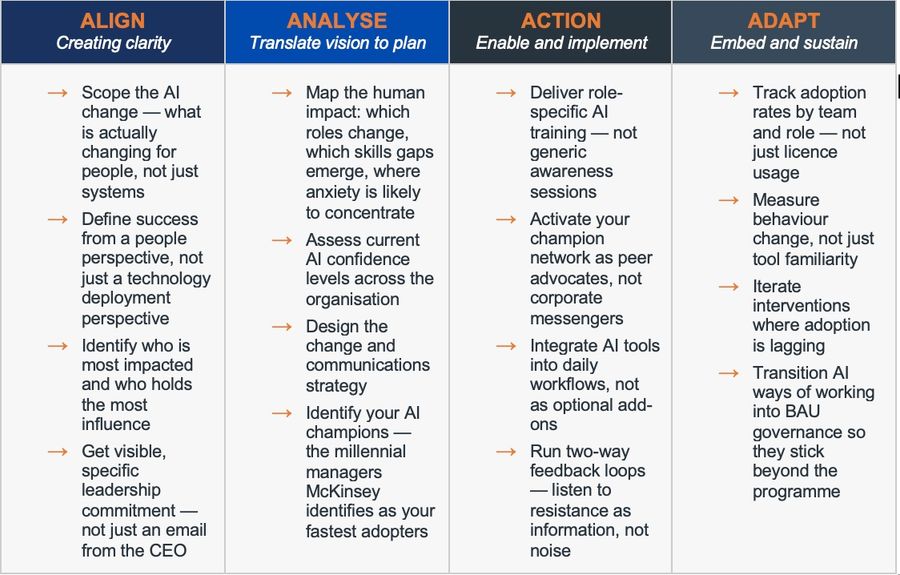
The critical principle running through all four phases is this: AI adoption change management must be built around workflow integration, not training delivery. McKinsey's research is explicit on this point — 48% of employees say they would use AI tools more if they received formal training, and 45% say they would use them more if they were integrated into their daily workflows. Both are necessary. Neither alone is sufficient.
Building AI confidence in sceptical teams
Scepticism about AI is not a problem to be managed. It is information to be acted on.
In almost every AI rollout I have seen, the loudest sceptics fall into two categories. The first is people who have legitimate concerns about the impact of AI on their role that have not been addressed honestly. The second is people who are anxious about their own capability to adapt and are projecting that anxiety as criticism of the technology.
Both groups need a response — but they need different responses. The first group needs honest, specific answers about what changes and what does not. The second group needs low-stakes opportunities to build confidence through practice, not reassurance through messaging.
What actually builds AI confidence
- Role-specific practice, not generic awareness: people build confidence by using AI on tasks they actually do, not by watching demonstrations of what AI can do in the abstract.
- Visible peer adoption: McKinsey identifies AI champions — particularly millennial managers — as the most powerful influence on team adoption. Formal champion programmes that give these individuals a sanctioned role accelerate adoption faster than any top-down communication.
- Psychological safety around failure: teams that are afraid of looking incompetent will avoid AI tools rather than risk visible failure. Leaders who normalise experimentation and make mistakes acceptable create the conditions for genuine adoption.
- Honest communication about the future of roles: the single biggest driver of AI anxiety is uncertainty about job security. Organisations that address this directly and specifically — rather than with generic reassurances about AI 'augmenting not replacing' — create significantly better conditions for adoption.
Measuring AI adoption success: the metrics that matter
One of the clearest signals that change management is not being taken seriously in an AI program is when success is measured by deployment metrics — licences activated, training sessions completed, go-live achieved on time. These are output metrics. They measure activity, not outcomes.
Real AI adoption success is measured by behaviour change — and behaviour change requires a different measurement framework.

The adoption rate and depth of use metrics are the two most critical in the first 90 days. A high activation rate with low depth of use tells you that people are using AI for low-risk, low-value tasks — spell-checking, summarising meeting notes — rather than the workflow integration that drives real productivity gains. This pattern is extremely common, and it is the leading indicator of an AI programme that will quietly fail to deliver ROI despite appearing to be on track.
Frequently asked questions
How do you manage the people side of an AI rollout?
Managing the people side of an AI rollout requires a structured change management approach that runs parallel to — and is resourced as seriously as — the technical implementation. This means scoping the human impact before deployment, segmenting your workforce by AI readiness and role impact, designing role-specific capability programs rather than generic training, activating a network of AI champions, and tracking adoption behaviours rather than deployment metrics. The most important principle is that adoption is not a communications problem — it is a behaviour change challenge that requires sustained, structured intervention.
Why do AI transformations fail?
The evidence is consistent across multiple large-scale studies: AI transformations fail primarily because of people and change management failures, not technology failures. McKinsey's 2025 research found that while 88% of organisations are using AI, only 1% have reached AI maturity. The gap is explained by insufficient investment in the people side: inadequate change leadership, generic rather than role-specific capability building, adoption measured at deployment rather than behaviour change, and the absence of governance structures that embed new AI ways of working into BAU. Technology quality is rarely the limiting factor.
How much should we invest in change management for an AI programme?
The generally accepted benchmark for change management investment in large-scale technology programmes is 15 to 20 percent of total programme cost. In practice, most organisations spend significantly less — and pay for it in the form of low adoption rates, re-training costs, and an ROI case that never materialises. The right framing is not 'how much does change management cost?' but 'what does it cost us if adoption fails?' A programme that delivers 40% adoption instead of 90% does not just underperform — it actively damages workforce confidence in future change initiatives.
Want to learn how to deliver change?
See our Change Readiness modules in HumAIn Impact’s Learning Studio.
https://www.humainimpact.com/change-engine
Anchor reading
The research cited throughout this article draws primarily on McKinsey & Company's Superagency in the Workplace: Empowering People to Unlock AI's Full Potential (January 2025) — a survey of 3,613 employees and 238 C-level executives across Australia, the US, India, New Zealand, Singapore and the UK. It is the most comprehensive study of AI adoption and workforce readiness currently available and essential reading for any leader managing an AI programme.
→McKinsey & Company: Superagency in the Workplace (2025)
→McKinsey & Company: Reconfiguring Work — Change Management in the Age of Gen AI (2025)