
What is an AI-powered change management platform?
By Emily Zhang, Founder — HumAIn Impact | 15+ years in change management across KPMG, CBA, Westpac · 15 June 2026
The global change management software market is built for enterprises. HumAIn Impact was built for the businesses that everyone else forgot — the scaling SMB navigating real transformation without a change team, a Big 4 budget, or a methodology PhD.
If you have searched for change management software recently, you have probably noticed two things. First, most of what comes up is built for enterprise — expensive, complex, and designed for organisations with a dedicated change team to operate it. Second, almost none of it is Australian.
The global change management software market is dominated by platforms like Prosci's suite, OCM Solution, Smartsheets — each excellent in specific contexts, and each either priced for Fortune 500 budgets, focused on a narrow slice of the change lifecycle, or built around methodology frameworks developed decades before AI existed.
HumAIn Impact was founded to fill the gap that none of them address: a modern, AI-native change management platform designed specifically for organisations that need structured, end-to-end change capability without a dedicated change team — and without enterprise-level spend.
This article explains what an AI-powered change management platform actually is, how it differs from legacy change templates, what to look for when evaluating options, and how HumAIn Impact compares for different organisation types and team sizes.
What to look for in a change management tool
Before evaluating any specific platform, it is worth being clear on what change management software should actually do — because the category is used loosely to describe products that do very different things.
At its broadest, change management software refers to any platform that helps organisations plan, deliver, and measure the people side of change. The critical phrase is 'people side.' There is a meaningful distinction between:
- Project management tools (Asana, Monday.com, Jira) — which manage tasks and timelines but have no change-specific methodology or people-adoption focus.
- Digital adoption platforms (WalkMe, Whatfix) — which provide in-app guidance for software rollouts but do not address the strategic, organisational change layer.
- IT service management tools (ServiceNow, BMC Helix) — which manage technical change processes but are not designed for organisational or people change.
- Organisational change management platforms (Prosci suite, OCM Solution, HumAIn Impact) — which address the full lifecycle of people change: scoping, planning, stakeholder engagement, communications, capability building, and adoption tracking.
Within the OCM category specifically, the criteria that matter most for SMBs evaluating a platform are:
End-to-end methodology coverage
The platform should support the full change lifecycle — from scoping and planning through to post-implementation adoption and embedding. Tools that cover only one phase (communications planning, or readiness assessment in isolation) require additional tools to complete the picture, which creates the fragmentation and governance gaps that most SMBs are trying to solve.
Built for non-specialists
Most change management platforms assume the user already understands change management methodology. For SMBs where change is managed by a project manager, HR generalist, or operations lead, this assumption is a critical flaw. The platform should teach the methodology while the user applies it — guiding decisions, pre-filling content, and surfacing best practice in context rather than requiring prior expertise.
Single system of truth
Change data — stakeholder maps, impact assessments, communications plans, adoption metrics — should live in one place, accessible to the whole team, in real time. A tool that generates disconnected documents defeats the purpose of having a system.
Practical pricing for SMB scale
Enterprise change management platforms routinely charge per-seat or per-project at rates that assume a dedicated change team and a large programme budget. For SMBs, the economics need to work at a flat, predictable cost that covers the whole organisation without a procurement exercise.
Microsoft-native compatibility
For the overwhelming majority of Australian SMBs, Microsoft 365 is the operating environment. A change management platform that does not output to editable Office formats creates adoption friction and data sovereignty concerns that SMB decision-makers should not have to accept.
The problem with legacy change management software
The established change management tools on the market were built for a specific context: large enterprises with dedicated change teams, significant program budgets, and staff with formal change management qualifications. In that context, tools like Prosci's suite, OCM Solution, and The Change Compass do exactly what they are designed to do.
The problem is that this context describes a shrinking minority of the organisations that actually need change management support.
They are built around methodologies developed before AI existed
Prosci's ADKAR model — the most widely adopted change framework in the world — was developed by Jeff Hiatt in 1998 after studying the change patterns of more than 700 organisations. It is a genuinely powerful framework for individual change management. It was also developed 25 years before generative AI existed, in a world where the pace, complexity, and nature of organisational change looked fundamentally different from today.
Legacy tools built around ADKAR and Kotter's 8-Step model apply these frameworks through static templates, manual tracking, and consultant-led delivery. They are not designed to respond dynamically to an organisation's specific context, pre-fill content based on what they know about a project, or provide intelligent guidance at the point of decision. They require expertise to operate effectively — which is precisely what most SMBs do not have.
They are prohibitively expensive for most organisations
Enterprise change management platforms are priced accordingly. Prosci certification alone costs several thousand dollars per person. Full platform subscriptions for tools like OCM Solution or The Change Compass — designed for multiple concurrent projects with large change teams — are priced at a level that assumes a program office, not approachable by SMB exec juggling five priorities. The Change Management Institute (CMI) albeit global are technical by design, but it’s intuitive application to ‘on the job’ learning in the real workplace is becoming more misaligned due to the faster pace of change demands.
For a 200-person business managing its first major AI or Technology rollout, this creates a binary and false choice: spend significantly on enterprise tooling you do not have the headcount to operate, or manage change with spreadsheets and good intentions.
They create dependency, not capability
The dominant model in legacy change management is to hire a certified practitioner or consultant to operate the methodology on behalf of the organisation. The organisation gets a well-managed program. It does not get any better at managing change itself.
This model made sense when change was episodic — a system implementation every few years, a restructure every decade. It makes no sense in a world where AI adoption, process redesign, and structural change are continuous. Organisations that cannot build internal change capability will permanently depend on external support — at permanent external cost.
Legacy change management was designed for episodic transformation in large organisations. AI-native change management is designed for continuous change in organisations of any size.
AI-native vs traditional change tools: what is the difference?
The term AI-native is used loosely in software marketing — often meaning little more than 'we have added a ChatGPT integration.' It is worth being specific about what genuine AI-native design means in a change management context, and why it matters.
A traditional change management tool provides a structure and templates. The user brings the expertise. The tool stores and organises the outputs.
An AI-native change management platform provides the structure, the expertise, and the intelligence. It guides the user through the methodology, pre-fills content based on project context, surfaces relevant best practice at the point of need, and learns from the data generated across the change programme to improve its recommendations.
The practical difference is significant for an SMB where the person managing change is not a change specialist:
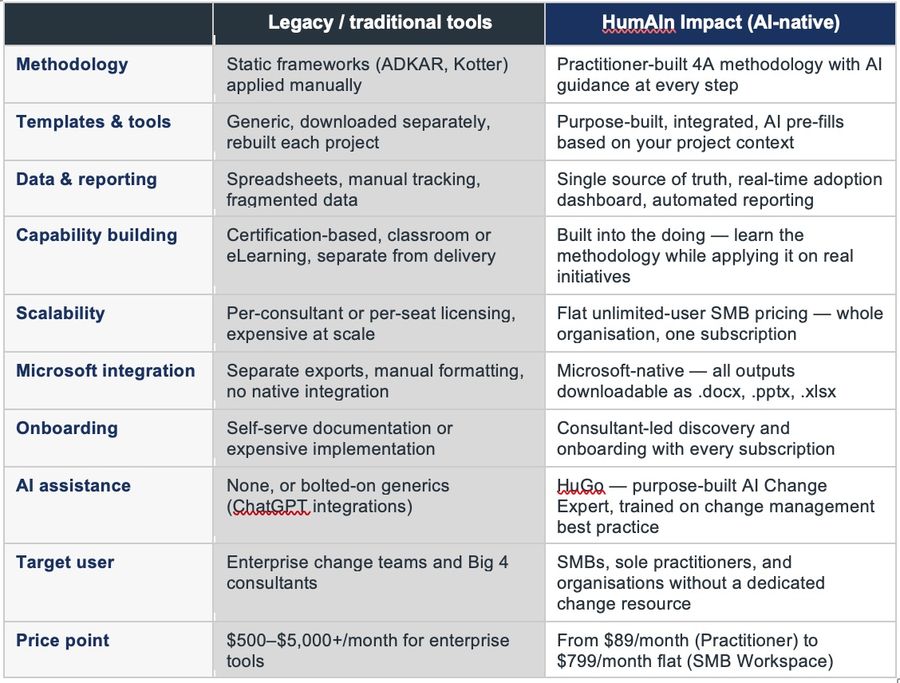
The comparison above is not intended to diminish the value of established tools in their target context. The point is that neither of those tools was designed for an operations manager at a 180-person logistics company trying to manage their first ERP rollout without a change manager.
HumAIn Impact platform overview: the 5 core components
HumAIn Impact is built around five integrated components that together provide end-to-end change management capability — from initial readiness assessment through to embedded adoption and ongoing governance. Each component is designed to work as part of the whole system, not as a standalone tool.
01
HumAIn Change Transformation Playbook
What it does: A complete end-to-end change management playbook built on the 4A methodology — Align, Analyse, Action, Adapt. Step-by-step guidance across every phase of change delivery.
Best for: Everyone using the platform — sets the methodology foundation
The value: Replaces the need to know change management before you start. Learn the discipline while applying it.
02
AI Organisation Diagnostic Tool
What it does: An AI-powered readiness assessment that scores your organisation across eight dimensions: strategy, people, culture, data, technology, governance, capability, and change management.
Best for: Completed in Discovery Session with a HumAIn consultant
The value: Turns subjective 'we think we're ready' into scored, evidence-based gap analysis. The foundation for every engagement.
03
Change Scoping Roadmap
What it does: An AI-generated phased change roadmap built from your diagnostic results. Outputs include complexity assessment, timeline, change streams, and resource requirements.
Best for: Project leaders and executives before initiating a change programme
The value: Eliminates the blank page problem. A complete, phased plan generated in minutes — not weeks.
04
AI-Powered Change Tools
What it does: A full suite of AI-guided change delivery tools covering stakeholder mapping, impact assessment, communications planning, readiness assessment, adoption tracking, and post-implementation governance.
Best for: The team leading and delivering change — HR, Ops, Project Managers, leaders
The value: Guides the user through best-practice change delivery while building capability. You are not just using a tool — you are learning change management in the doing.
05
HuGo — AI Change Expert
What it does: HuGo is HumAIn Impact's purpose-built AI change assistant. Trained on change management best practice, methodology, and real-world delivery patterns — available at every step of the platform.
Best for: Every platform user — available on-demand throughout the Change Engine
The value: The equivalent of having a senior change practitioner available 24/7. Answers change questions, pre-fills templates, suggests interventions, and guides decisions.
The five components are accessed through the HumAIn Change Engine — the platform workspace where all project data, tools, templates, and progress tracking live in one place. The Change Engine is Microsoft-native: every output is downloadable and editable in PowerPoint, Word, and Excel formats, and the platform integrates with Microsoft Teams and SharePoint.
Change management tools for different team sizes
One of the most common mistakes organisations make when evaluating change management software is selecting a tool designed for a different organisation size and type. An enterprise platform used by a 150-person team is over-engineered and under-adopted. A practitioner tool used by a 400-person organisation quickly hits its limits.
HumAIn Impact is designed to scale — the same methodology and platform serves sole practitioners, SMBs, and enterprise organisations, with pricing and engagement models sized accordingly. See our transparent pricing plans here.
What change management SaaS is available in Australia?
Australia's change management software market is almost entirely populated by international platforms designed for US or UK enterprise contexts. The most commonly used tools in Australian organisations are Prosci's suite, OCM Solution, The Change Compass (which is Australian-built and enterprise-focused), and general-purpose tools like Microsoft Project and SharePoint adapted for change tracking.
For Australian SMBs specifically, the gap is significant. The Change Compass is purpose-built for large Australian enterprises managing complex change portfolios — excellent for its target market and not designed for a 200-person business without a change team. Prosci tools require certified practitioners to operate effectively. International platforms carry data sovereignty considerations that are increasingly relevant under Australia's Privacy Act and evolving AI governance frameworks.
HumAIn Impact is the only AI-native change management platform built specifically for the Australian SMB market — Microsoft-hosted, designed for organisations without dedicated change resources, and priced at a point that makes structured change management accessible without enterprise-level investment.
HumAIn Impact is Australia's only AI-native change management platform built specifically for SMBs — founder-led, Microsoft-native, and designed to build change capability from the inside out.
What are the best change management tools for small businesses?
For small and medium businesses evaluating change management tools, the honest answer is that most of the widely reviewed options are not designed for you. They are designed for organisations with dedicated change teams, significant programme budgets, and staff with formal change qualifications.
The criteria that should drive tool selection for an SMB are different from enterprise criteria:
- Does it guide you through the methodology, or does it assume you already know it?
- Can it be operated by a non-specialist — a project manager, HR lead, or operations manager?
- Does it provide a single source of truth for all change data, or does it generate disconnected documents?
- Is it priced for an SMB budget — flat, predictable, and not per-seat at enterprise rates?
- Does it build internal capability over time, or does it create ongoing dependency on external support?
- Is it designed for the Australian context — data sovereignty, Microsoft ecosystem, local support?
Evaluated against these criteria, HumAIn Impact is a top platform on the Australian market that addresses all six. For organisations that want the rigour of enterprise change management methodology delivered at SMB scale and price.
Get in touch if you want to learn more about HumAIn Impact’s Change Engine
emily@humainimpact.com