How to Prepare Employees for AI: A Change Management Guide
Emily Zhang · 17 November 2026
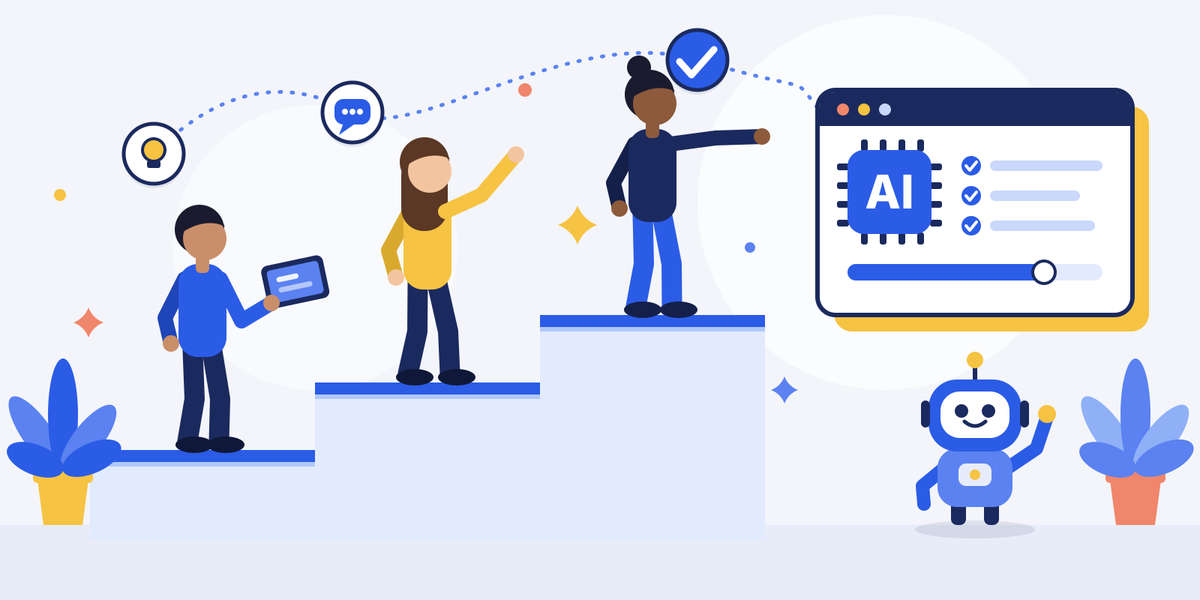
How do you prepare employees for AI adoption? Organisations can prepare employees for AI by clearly communicating why AI is being introduced, involving people in the transformation, understanding how roles and skills may change, providing practical AI training, establishing responsible AI guidelines and equipping leaders to manage the change. The goal isn't to make every employee an AI expert. It's to build the confidence, capability and clarity people need to work effectively with AI. AI adoption starts with people.
A successful AI adoption strategy needs more than a technology roadmap. It needs a people roadmap.
Employees need to understand what AI will change, what will remain human and how they will be supported through the transition.
This means moving beyond broad statements such as “AI will transform the way we work” and explaining what that actually means for different roles, teams and ways of working.
Where AI can automate repetitive activities, people may have more opportunity to focus on judgement, creativity, relationships, problem-solving and higher-value work.
Instead of asking, “What will AI take away from me?”, ask, “What could AI help me do better?”
Address the fear of AI openly
One of the biggest barriers to AI adoption is uncertainty.
Employees may be wondering whether AI will replace their job, whether their existing skills will remain relevant or what will be expected of them as technology evolves.
These are legitimate concerns, and organisations shouldn't try to address them with overly optimistic messaging.
Instead, leaders should be transparent about what is known, acknowledge what is still evolving and explain how employees will be supported.
Trust grows when organisations communicate honestly — including when they don't yet have every answer.
Involve employees in AI adoption
Employees are often best placed to identify where AI could create practical value.
They understand the repetitive tasks, process frustrations and customer challenges that may not be obvious from an executive or technology perspective.
Bringing employees into the conversation early can help organisations identify meaningful use cases while also creating ownership of the change.
Ask people where AI could remove unnecessary effort, improve the customer experience or help them spend more time on work that matters.
Employee involvement isn't simply a change-management activity. It can be a source of better AI opportunities.
Build practical AI capability
AI training should be connected to the work employees actually do.
Rather than relying on generic awareness sessions, organisations should create opportunities for people to experiment with AI in relevant, low-risk situations and gradually build confidence.
A practical learning journey can move from:
Awareness → Understanding → Experimentation → Application → Adoption
The objective is not simply to teach people how to use a tool. It is to help them understand when AI is useful, how to use it responsibly and where human judgement remains essential.
Equip leaders to lead the change
Leaders play a critical role in AI adoption.
Employees will look to their leaders to understand why AI is being introduced, how their work may change and what the organisation expects from them.
Leaders therefore need more than an understanding of the technology. They need the confidence to have meaningful conversations about impact, uncertainty, skills and opportunities.
Effective AI change leadership isn't about having every answer, though it’s about creating confidence that the organisation is navigating the change responsibly.
Make responsible AI part of adoption
Employee confidence also depends on trust.
People need clear guidance about privacy, confidentiality, accuracy, security, intellectual property and when human oversight is required.
Responsible AI should not be treated as a separate compliance exercise. It should become part of everyday ways of working.
When employees understand the boundaries and have clear guardrails, they can experiment with AI more confidently and responsibly.
Real measures of effect, not just usage
AI adoption shouldn't be measured only by how many employees have access to a tool, tokens used or how often they use it.
Organisations should also understand whether people feel confident using AI, whether leaders are ready to support adoption and whether AI is genuinely improving the way work gets done (is it bringing actual value)?
The ultimate measure isn't simply:
“Are people using AI?”
It is “How do we know if they are using AI effectively, and bringing value to the overall business?”
This means considering the employee experience from the beginning of the transformation — not after the technology has already been selected and deployed.
The HumAIN AI Readiness Framework
A practical approach can be built around five connected stages:
Understand — assess how AI could affect roles, skills and ways of working.
Engage — involve employees and leaders in identifying opportunities and addressing concerns.
Enable — build the AI literacy, skills and confidence people need.
Adopt — embed AI into everyday behaviours, processes and workflows.
Sustain — measure adoption, confidence and business impact, then continuously adapt.
Together, these stages help move AI from technology deployment to sustainable organisational change.
Preparing employees for AI is a business priority
AI adoption is moving quickly, but speed alone shouldn't define successful transformation.
Organisations that combine technology capability with human readiness will be better positioned to realise sustainable value from AI.
The future of AI isn't simply about what technology can do. It's about what people can achieve with it.
Further reference: www.mckinsey.com/capabilities/quantumblack/our-insights/the-state-of-ai