
Change management training for leaders: what works and what doesn't
By Emily Zhang, Founder — HumAIn Impact | 15+ years leading change across KPMG, CBA, Westpac, startups · 15 June 2026

The leader who is visibly supportive but ineffective in practice is not a leadership problem. It is a capability problem. And it is the most common — and most costly — failure mode in change management.
There is a particular kind of leadership failure that is almost impossible to see from the inside.
The leader sends the email. They appear at the town hall. They say the right things in the right meetings. They tell the project team they are fully committed. They genuinely believe they are doing everything a good sponsor should do.
And yet the adoption is stalling. The resistance is building. The team is uncertain. And somehow — despite everyone agreeing that leadership is critical to change success — this leader's visible support is not translating into anything the organisation can actually feel.
I have seen this pattern more times than I can count across 15 years in change management at KPMG, CBA, Westpac, and a range of scaling businesses. It is not a character problem. It is a capability problem. And it is extraordinarily common.
Prosci's Best Practices in Change Management research — drawing on 25 years of global data — identifies active and visible executive sponsorship as the number one contributor to change success, by a three-to-one margin over the next most important factor. Yet in their most recent benchmarking study, 52% of respondents said their sponsors did not have an adequate understanding of their role in change.
That gap — between the importance of change leadership and leaders' actual capability to deliver it — is precisely what this article addresses.
What change capability actually means — and why most organisations don't have it
Change capability is one of those terms that gets used freely and defined rarely. So let me be specific.
Change capability is not the ability to manage a change project. That is change management — a set of skills and processes that can be applied to a discrete initiative. Change capability is something broader and more durable: the organisational muscle to navigate change continuously, confidently, and consistently — with or without external support.
An organisation with genuine change capability does not need to bring in a consultant every time it faces a significant transformation. Its leaders know how to sponsor change effectively. Its managers know how to support their teams through uncertainty. Its people have been through enough well-managed change that they approach the next one with resilience rather than resistance.
Most organisations do not have this. And the reason — in my experience — is not that change is too hard or too complex. It is that capability has never been deliberately built. Change has always been managed by bringing in external resources, or by relying on the same few internal people who happen to have change backgrounds. The organisation gets through the programme. It does not get any better at change itself.
The difference between change management and change capability
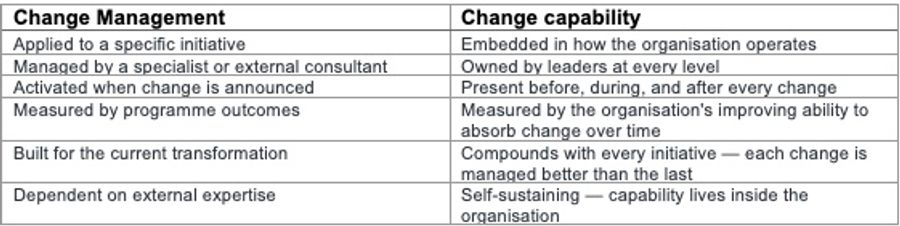
The visibility trap: why good intentions aren't enough
Back to the leader at the start of this article. The one who is visibly supportive but whose sponsorship is not translating into results.
What is actually happening in that scenario? In my experience, three things simultaneously.
They are present, but not specific
The leader communicates support for the change in general terms: 'this is important for the business,' 'I'm fully behind this,' 'we need to embrace the future.' These statements are all true. They are also completely useless to the person who is worried about whether their role will still exist in six months, or whether the new system will make their job harder.
Effective change leadership is specific. It names the change precisely. It explains the 'why' in terms that connect to the individual, not just the organisation. It addresses the hard questions directly — including the ones nobody has asked out loud yet — rather than staying at the level of strategic endorsement.
They are active at launch, invisible during delivery
The most common pattern I see is heavy leadership involvement at the beginning of a change programme — the kickoff communication, the town hall, the all-staff email — followed by a gradual disappearance as the operational demands of running the business reassert themselves.
Prosci's research is explicit on this: sponsors must actively and visibly participate throughout the project — not just at launch. The organisation takes its cues from what leaders do after the announcement, not from the announcement itself. When leadership goes quiet during the hard middle part of a change programme, the message received is that this is no longer a priority.
They delegate sponsorship to the change team
This is perhaps the most misunderstood aspect of change leadership. The sponsor is not the person who authorises the change management budget and delegates delivery to the change team. The sponsor is the person who visibly, actively, and continuously demonstrates their own commitment to the new way of working.
The change team cannot sponsor on behalf of a leader. They can prepare talking points, schedule town halls, and create every condition for effective sponsorship. But the moment of a leader standing in front of their team and demonstrating genuine, specific, personal commitment to the change — that cannot be proxied.
The change team cannot sponsor on behalf of a leader. Effective sponsorship is a personal act. It requires the leader to show up — specifically, consistently, and visibly — throughout the entire change journey. Not just at launch.
Change management training for leaders: what works and what doesn't
The response to the capability gap in most organisations is a training program. And most training programs do not work — not because the content is wrong, but because they are designed around the wrong theory of change.
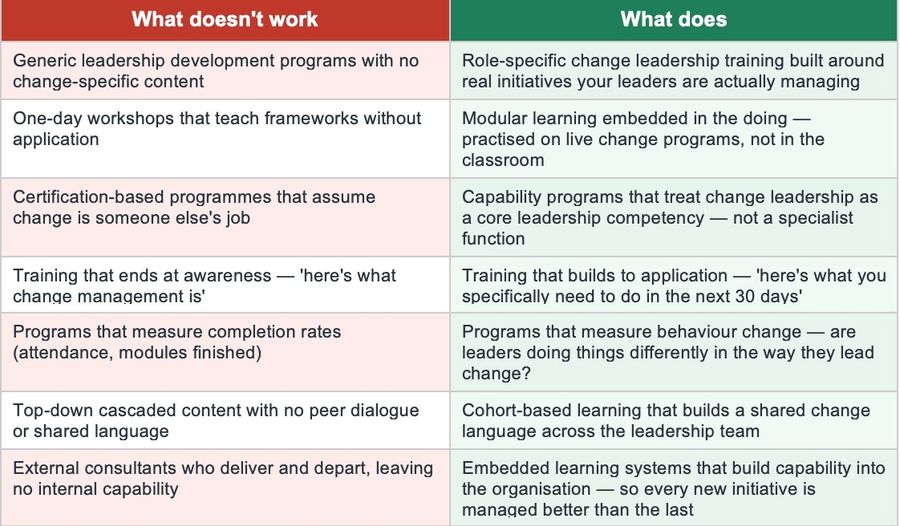
The assumption embedded in most leadership development program is that knowledge transfer produces behaviour change. Learn the framework, understand the model, pass the assessment — and capability will follow. Often there is zero correlation between program participation and performance ratings, suggests this assumption is wrong.
Behaviour change requires more than knowledge. It requires practice, feedback, application in context, and a structure that makes new behaviours easier than old ones. Here is what that means in practice for change leadership development:
Change capability for leaders: the 4 mindset shifts
Beyond the practical skills of change leadership — stakeholder management, communication planning, resistance handling — there are four fundamental mindset shifts that separate leaders who are genuinely effective in change from those who are merely supportive.
These are not personality traits. They are learned perspectives that can be developed deliberately. In my experience, leaders who make these four shifts become dramatically more effective at leading change — not because they have learned a new technique, but because they see their role differently.
MINDSET SHIFT 01From managing the announcement to owning the adoption
From: My job is to communicate the change and then let the project team manage the rest.
To: My job begins when the announcement is made. I own the adoption outcome — not just the launch moment.
In practice: Effective sponsors track adoption data for their team. They ask specific questions about how their people are going. They intervene early when adoption is lagging — not because the change team escalates, but because they are watching for it themselves.
Mindset Change 1: From being supportive to being specific
From: I have communicated that I support this change and I am available if people have questions.
To: I know specifically what is changing for every person on my team, and I have had individual conversations with those most affected.
In practice: Good change leadership requires the leader to go beyond general endorsement to specific, personal engagement. This means knowing the impact map for your team, not delegating it entirely to HR or the project team. It means being able to answer: 'What does this mean for you specifically?' — for every person in your team who needs to hear it.
Mindset Change 2: From hearing resistance to treating it as information
From: Resistance is a problem to be managed. People who push back need to be brought on board or moved past.
To: Resistance is information. It tells me what I have not yet addressed clearly enough, where my people are in the change journey, and where I need to put my attention.
In practice: The most effective change leaders I have worked with are genuinely curious about resistance. They treat a sceptical team member not as an obstacle but as an early signal of something important. The question is never 'how do I get them on board?' It is 'what are they telling me that I have not yet heard?'
Mindset change 3: From role-modelling in theory to role-modelling in practice
From: I have told my team that I support this change and they should embrace it.
To: I am visibly and specifically using the new system, following the new process, and demonstrating the new behaviour — every day, in a way my team can see.
In practice: Nothing destroys change credibility faster than a leader who endorses a change and then continues operating in the old way. Role-modelling is a behavioural act. It requires the leader to personally adopt the change before asking their team to do so, and to do it visibly enough that their team can observe it.
How to build lasting change capability without hiring a change team
The capability gap in most organisations is real — but the solution is not always to hire. In my experience, the most change-capable organisations are not the ones with the largest change teams. They are the ones where change leadership is treated as a core leadership competency, developed deliberately, and reinforced through every change program the organisation undertakes.
Building that capability without hiring a dedicated change team requires three key things:
A consistent methodology that leaders can internalise
You cannot build change leadership capability in an organisation that uses a different approach on every initiative. Leaders need a consistent methodology — a shared language for what the phases of change look like, what good looks like at each stage, and what their specific role is. Without that consistency, every new program requires re-education, and the learning from one initiative never transfers to the next.
HumAIn Impact's 4A methodology — Align, Analyse, Action, Adapt — provides that consistent framework. It is simple enough to be understood by non-specialists, rigorous enough to be applied on complex programmes, and embedded in the platform so that every leader using HumAIn is working from the same playbook.
Learning that is embedded in delivery, not separate from it
The most effective change capability development happens in the doing. Leaders who apply change methodology on a real initiative, supported by structured guidance and AI-assisted tools, learn faster and retain more than those who complete a training program and then return to their normal work.
This is the principle behind HumAIn's Learning Studio — not a standalone training program, but capability modules that are integrated into the platform and designed to be applied on live initiatives. The learning and the delivery happen simultaneously and allows you to build the training and communication briefings that suits your organisation.
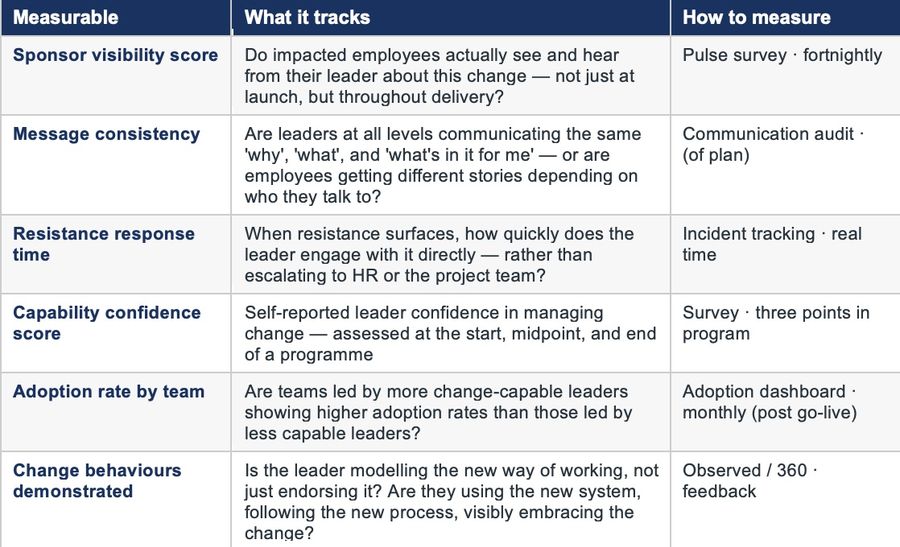
Measurement that holds capability accountable
Change capability will not improve if it is never measured. And measuring it requires looking at behaviour, not just knowledge — which means going beyond training completion rates to track whether leaders are actually doing things differently.
Introducing the HumAIn Learning Studio
HumAIn Impact's Learning Studio is the practical answer to the leadership capability gap. Not a certification program. Not a generic leadership development course. A structured, modular change capability curriculum built specifically for the leaders who are responsible for change in their organisations — and designed to be applied on real initiatives from day one.
The Learning Studio is built around five modules, each targeting a specific leadership audience and capability need:
HumAIn Learning Studio
Change capability training for leaders and teams — built into the HumAIn platform
01
Change Foundations for Leaders
Audience: All leaders — foundational
What change management actually is, why it matters, and what your specific role as a leader is in making it work. Builds the shared language your leadership team needs to lead change consistently.
02
The Change-Able Leader
Audience: Senior leaders and executives
The four mindset shifts, active sponsorship in practice, and how to build and sustain your coalition. Designed for leaders managing significant transformation programs.
03
Leading Teams Through Change
Audience: Team leaders and managers
How to have honest change conversations with your team. Managing resistance at the team level. Keeping people engaged when certainty is low. Practical skills for the leaders closest to the people.
04
Change for Non-Change Specialists
Audience: Project managers, HR generalists, Ops leads
Structured introduction to change methodology for people who find themselves managing change without a change management background. The practical toolkit for the accidental change manager.
05
AI Change Leadership
Audience: C-suite, CTO, CPO, COO
Specifically designed for leaders managing AI adoption programs. Covers the unique people challenges of AI rollouts, how to build AI confidence in sceptical teams, and what active sponsorship looks like in an AI transformation context.
All Learning Studio AI capabilities and modules are available within the HumAIn Impact platform — included in the HumAIn Engine subscription and available as standalone modules for teams and organisations on other plans. Modules are designed to be completed in sequence or as standalone development based on your leadership team's specific needs.
→Access the Learning Studio at humainimpact.com.au
Book a Discovery Session to discuss a tailored leadership capability program
Frequently asked questions
How do you build change capability in an organisation?
Building change capability in an organisation requires three things working together: a consistent methodology that all leaders can learn and internalise, development that is embedded in real delivery rather than separated from it, and measurement that tracks behaviour change rather than training completion. Capability builds through repeated, structured practice across multiple initiatives — each change progra should be managed better than the last, with learning compounding across the organisation over time. HumAIn Impact's platform and Learning Studio are designed specifically to build change capability this way — through guided doing, not upfront certification.
What is change leadership capability?
Change leadership capability is the skill set, mindset, and behavioural repertoire that enables a leader to actively and effectively sponsor change — not just support it in principle. It includes the ability to communicate the 'why' of change specifically and credibly, to maintain visible engagement throughout delivery rather than just at launch, to treat resistance as information rather than opposition, and to personally model the new way of working in a way their team can observe. Prosci's 25 years of global research consistently identifies active and visible executive sponsorship as the number one contributor to change success — making change leadership capability one of the highest-leverage leadership investments any organisation can make.
How do you upskill leaders in change management?
The most effective approach to upskilling leaders in change management combines three elements: role-specific content that connects directly to the change initiatives the leader is currently managing (not generic frameworks); application in context — practising the skills on real programmes with structured guidance rather than in a classroom; and ongoing reinforcement through measurement and feedback, so that new behaviours are tracked and held to account. Generic leadership training programmes that treat change management as a module within broader leadership development consistently underperform against targeted, context-specific capability building. HumAIn Impact's Learning Studio is designed around these principles.
What is the difference between change management and change capability?
Change management refers to the structured process of planning, delivering, and measuring a specific change initiative. Change capability is the broader, sustained organisational ability to manage change continuously and effectively — without external dependency. An organisation that has change management but not change capability can deliver individual programmes well but starts from scratch on every new initiative. An organisation with genuine change capability gets progressively better at change over time — each initiative is faster, cheaper, and achieves higher adoption than the previous one, because the learning compounds across the organisation.
How long does it take to build genuine change leadership capability?
Meaningful improvement in individual change leadership behaviours is visible within a single program when the leader is given the right structure, tools, and guided support. Genuine organisational change capability — where change leadership is a consistent, self-sustaining competency across the leadership team — typically develops across three to five structured initiatives over 3- 6mths. The compound effect is significant: the fifth initiative managed with a consistent methodology and capable leadership typically achieves adoption rates two to three times higher than the first, at a fraction of the cost.